
See what your self-worth seems to require before you can feel okay
A sense of worth can feel stable until something important goes wrong. This assessment helps you look at whether achievement, approval, usefulness, comparison or another person's disappointment changes how much value you believe you have.
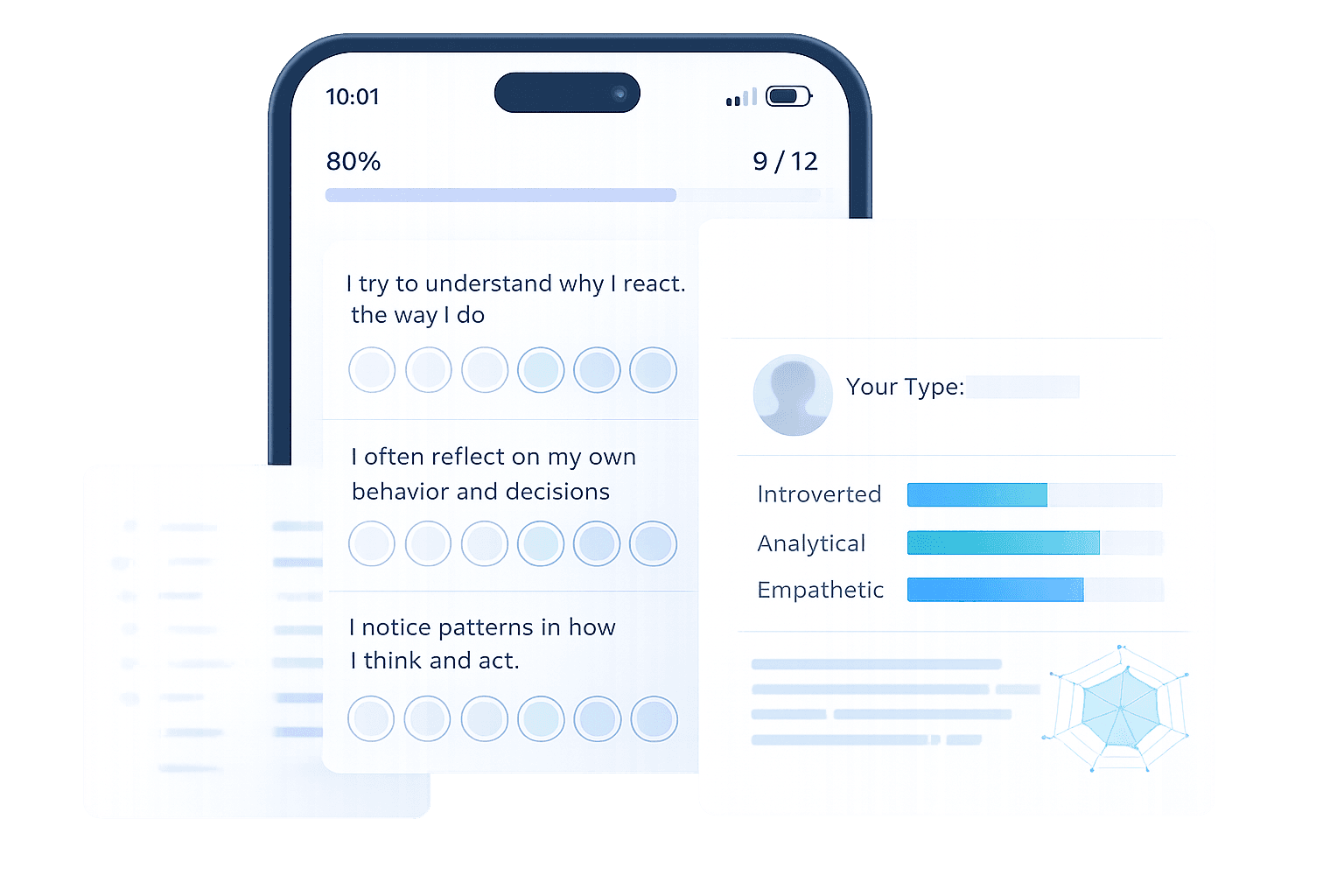

Notice where worth becomes conditional
Look at the moments when being productive, attractive, helpful, successful or approved of starts to feel like the price of being acceptable.

Find the parts of your value that survive disappointment
Explore whether you can make a mistake, be rejected, receive criticism or fall short of a goal without turning the event into proof that you matter less.
Trace what your sense of worth is tied to
Think about what raises your self-view
Use examples involving achievement, praise, being needed, appearance, belonging and the roles that make you feel secure or valuable.
Notice what makes that value feel threatened
Reflect on mistakes, comparison, rejection, criticism, disappointing someone and situations where another person's success makes your own value feel smaller.
Place self-worth inside the broader self-esteem result
Perself returns one overall self-esteem level rather than a separate self-worth score, so the report also considers acceptance, agency, boundaries and social resilience.
A stable sense of worth does not require constant proof
The report can help you see whether your self-view remains reasonably intact when performance, approval or relationships fluctuate. Relevant answers include whether you believe you matter after mistakes, feel worthy of care without constantly earning it, and can tolerate someone else's disappointment without treating it as a verdict on your value.
Self-worth overlaps strongly with self-esteem, which is why this route uses the same broader assessment. The final result is one overall self-esteem level. Its value here is in showing how conditional worth may connect with self-acceptance, reassurance, boundaries, comparison and the ability to recover after setbacks.
Self-worth test questions
Is self-worth the same as self-esteem?
Is self-worth the same as self-esteem?
They overlap closely. Self-worth focuses on the belief that you have value as a person, while self-esteem also includes how you evaluate yourself across competence, acceptance, boundaries and social experience. Perself measures the broader pattern.
Will I get a separate self-worth score?
Will I get a separate self-worth score?
No. The final result is one overall self-esteem level. Self-worth-related answers contribute to that result and are interpreted in the wider report.
What does conditional self-worth mean?
What does conditional self-worth mean?
It means your sense of value may depend heavily on meeting a condition such as succeeding, being useful, receiving approval, looking a certain way or avoiding disappointment. When the condition fails, self-value can fall with it.
Does caring about achievement mean my self-worth is unhealthy?
Does caring about achievement mean my self-worth is unhealthy?
No. Achievement can matter deeply without determining your entire value. The more useful distinction is whether a setback changes what you think about the result or what you think you are worth as a person.
Can self-worth be strong even when confidence is low?
Can self-worth be strong even when confidence is low?
Yes. You can feel inexperienced or uncertain in a situation while still believing you deserve respect and can learn. Confidence about performance and basic personal worth are related but not identical.
Is this the Rosenberg Self-Esteem Scale?
Is this the Rosenberg Self-Esteem Scale?
No. Perself is a broader proprietary self-esteem assessment and does not claim to be the Rosenberg Self-Esteem Scale or another validated self-worth instrument.
The question is not what makes you feel good. It is what makes you feel worthy.
Praise can feel good without being necessary for self-worth. Success can matter without becoming proof that you deserve respect. The distinction appears when the positive condition disappears: after a mistake, rejection, quiet period, lost role or comparison you did not win.
Conditional worth often sounds reasonable because the condition may be socially rewarded. “I matter when I am useful” can produce generosity. “I matter when I achieve” can produce ambition. The cost appears when rest, failure, dependence or ordinary imperfection begins to feel like a threat to identity rather than part of being human.
Looking at self-worth through the broader self-esteem assessment helps keep the question grounded. Worth is not only what you say you believe about yourself; it also shows up in what you tolerate, how much reassurance you need, whether you can recover, and whether your needs remain legitimate when nobody is applauding them.