
Understand what keeps repeating in your choices and reactions
Sometimes the useful question is not “What type am I?” but “Why does this situation keep bringing out the same version of me?” Perself's Self Awareness Test gives you a personality-pattern result and a detailed report to help you look closer.
By using this site, you agree with terms & conditions

Recognize the pattern before you judge the moment
The same argument, hesitation, need for approval, push for control or instinct to pull back can feel unrelated while it is happening. Seeing a broader pattern gives you a better question than simply deciding you handled one moment badly.

See where a strength starts costing you
Qualities that help you in one situation can create friction in another. Your report helps you look at both sides of a familiar tendency so self-reflection does not turn into either self-criticism or flattering labels.
Turn a familiar reaction into a better question
Think across more than one version of your life
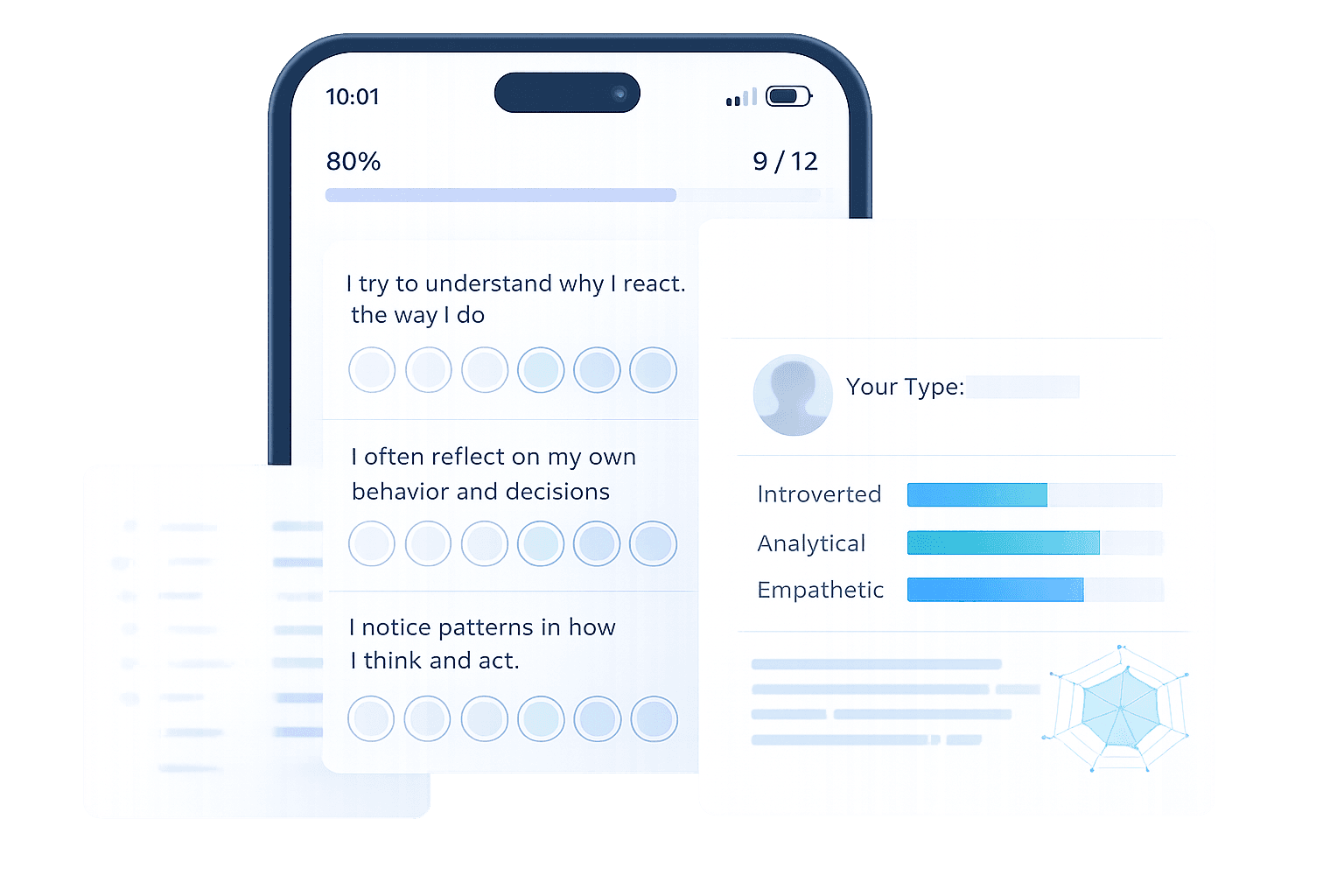
Answer 100 short statements from what is usually true across ordinary weeks, close relationships, work or study, decisions and stressful moments. The goal is your typical pattern, not your best performance.
See the pattern your answers favor
Your responses are compared across nine personality patterns. The result identifies the pattern with the strongest overall fit, giving you one focused place to begin rather than a list of disconnected observations.
Read for the trade-offs, not just the label
Use the report to notice where the pattern supports you, where it becomes rigid or costly, and which parts deserve a closer look in the situations that matter most to you.
The most useful part of a result is what it helps you notice next
The report follows your dominant pattern beyond a name. It looks at the motives and fears commonly associated with it, the strengths that can become pressure points, and the ways the pattern may show up when you relate, work, make decisions or deal with stress.
You do not need every sentence to feel exact for the report to be useful. The goal is to leave with more specific observations than you started with: what seems to repeat, when it changes, what you may be protecting or pursuing, and which response you would like to understand better next time it appears.
About Perself's Self Awareness Test
What is Perself's Self Awareness Test based on?
What is Perself's Self Awareness Test based on?
It uses a nine-pattern personality model. Your answers are compared across those patterns and the result identifies the one with the strongest overall fit, followed by a detailed report for reflection.
Will the test tell me who I really am?
Will the test tell me who I really am?
No single test can define a whole person. Perself gives you one structured lens on recurring tendencies. The useful question is where the description fits your life, where it does not, and what you learn from that comparison.
Why can the same pattern look different in different situations?
Why can the same pattern look different in different situations?
Context matters. A tendency that feels useful at work may create friction in a close relationship, and pressure can bring out a more rigid version of a response that is usually helpful. Read the result across several settings rather than expecting one behavior everywhere.
Should I answer as I am or as I want to be?
Should I answer as I am or as I want to be?
Answer from what is usually true in practice. Choosing the response that sounds most admirable may give you a cleaner self-image, but it gives you less useful material for reflection.
What do I receive after the test?
What do I receive after the test?
You receive your dominant personality pattern and a detailed report exploring its characteristic tendencies, motivations, relationships, work themes, stress responses and growth areas.
Is this a medical or psychological diagnosis?
Is this a medical or psychological diagnosis?
No. Perself's Self Awareness Test is designed for education and self-reflection. It does not diagnose or rule out a mental-health, personality or neurodevelopmental condition.
The moment is usually easier to notice than the pattern connecting it
Most of us can remember the obvious event: the conversation we replayed all evening, the decision we delayed, the criticism that stayed with us, or the moment we took over because letting someone else handle it felt uncomfortable. What is harder to see is whether a similar response appears elsewhere under a different surface.
Looking for a pattern does not mean forcing every experience into one explanation. It means comparing. When does the tendency show up? When does it disappear? What were you expecting, protecting, avoiding or trying to make happen? Which part helped, and which part created the problem you remember?
A personality report is useful when it makes those questions more precise. Perself gives you a starting pattern; your own examples decide how much of it belongs in the story you tell about yourself.