
Discover which attachment type best matches the way you protect connection and independence
Your answers are compared across five attachment profiles, from steadier security to patterns shaped more strongly by reassurance, self-reliance, fear, or inconsistency. The result shows which profile is strongest in your responses and what that may mean in real relationships.
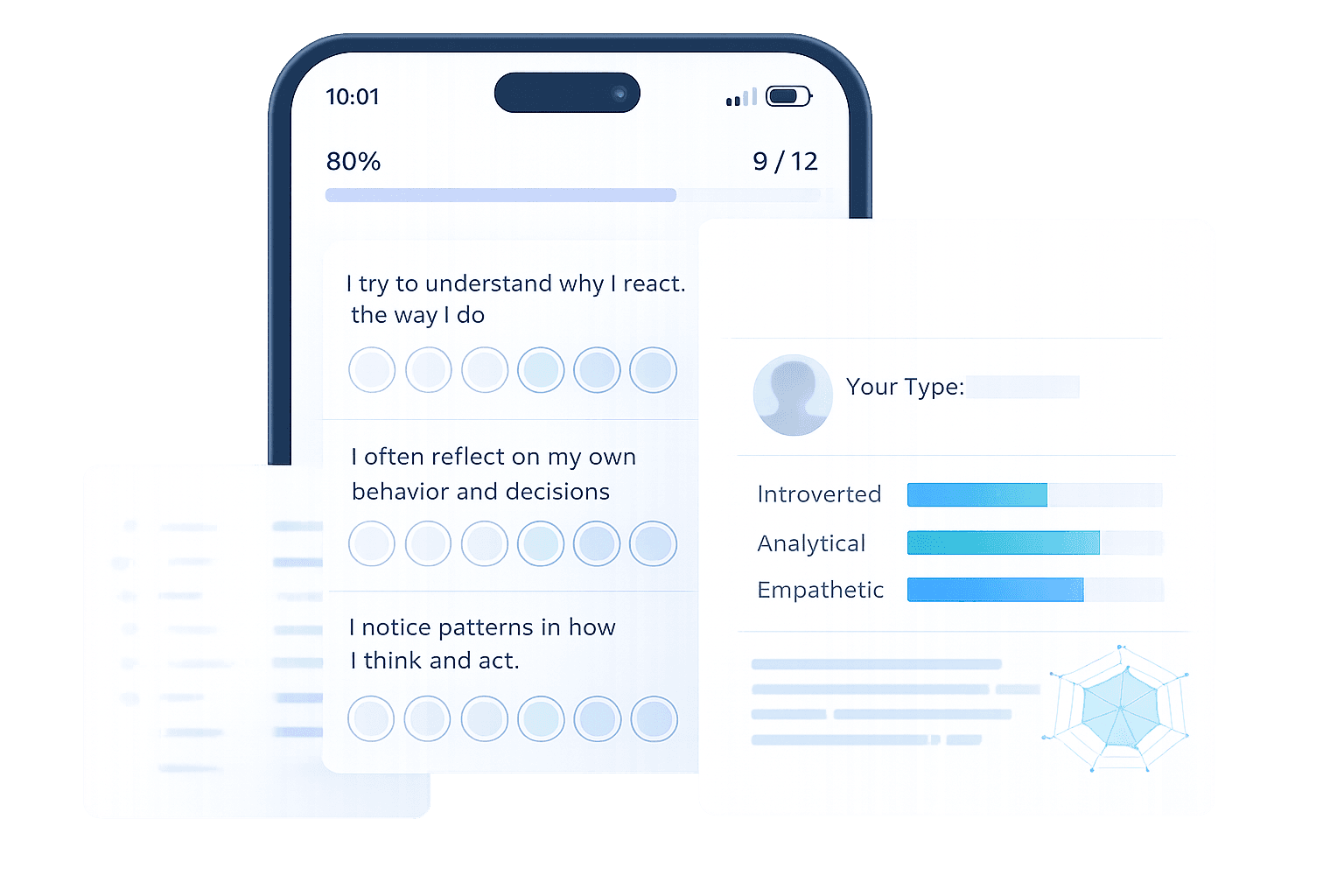

See which pattern leads when closeness matters
The most revealing differences often appear around trust, emotional openness, dependence, reassurance, boundaries, and what you do when a relationship feels less secure than usual.

Read the type as a pattern, not a box
A leading type summarizes the strongest theme in your answers. It does not mean every relationship looks the same or that you must recognize yourself in every sentence of the report.
How Perself identifies your leading attachment type
Answer across the full relationship picture
Think about trust, closeness, asking for support, needing space, handling conflict, setting boundaries, and what happens when another person's availability feels uncertain.
Your answers build five profile scores
The assessment groups responses by attachment profile and normalizes the scores before selecting the strongest pattern as your main result.
Read the type in context
Your report explains the leading profile through emotional patterns, communication, close relationships, work, responsibility, decision-making, strengths, and personal growth.
The type matters most when it explains a reaction you could not make sense of before
A useful type result should make ordinary moments more legible: why reassurance can feel urgent, why dependence can feel uncomfortable, why conflict changes your sense of safety, or why you can want closeness and still protect yourself from it.
Perself's five-profile model gives you a leading pattern rather than a clinical category. Use the report to see what fits, what does not, and which situations make the pattern strongest rather than treating the type as a fixed identity.
Attachment type test questions
How many attachment types does Perself use?
How many attachment types does Perself use?
Perself compares your answers across five profiles: The Secure Connector, The Anxious Seeker, The Independent Protector, The Fearful Connector, and The Unsteady Connector.
Why are Perself's type names different from the usual four-style labels?
Why are Perself's type names different from the usual four-style labels?
Perself uses its own profile names to describe patterns in the questionnaire and report. They are intended as plain-language self-reflection profiles rather than claims that this test is a validated four-category clinical instrument.
Will I get more than one type?
Will I get more than one type?
You receive one leading attachment profile based on the strongest normalized score. Other tendencies may still feel familiar, especially because attachment-related reactions can vary by context and relationship.
Can my attachment type change?
Can my attachment type change?
Attachment-related patterns can shift with experience, safety, stress, relationships, self-awareness, and therapy. Treat the result as a description of your current recurring tendencies rather than a permanent identity.
Is one attachment type better than the others?
Is one attachment type better than the others?
Security is generally associated with greater comfort balancing closeness and independence, but the purpose of the test is understanding your pattern, not grading your worth or predicting whether a relationship will succeed.
Is this a diagnostic personality type?
Is this a diagnostic personality type?
No. Perself's attachment types are educational self-report profiles, not psychiatric diagnoses or fixed personality classifications.
A type is useful only if it makes your real relationships easier to read
Attachment tests can become too abstract when the entire focus is on finding the right label. The stronger question is whether the result explains something observable about trust, closeness, self-reliance, reassurance, conflict, or repair.
Adult attachment is often studied through anxiety and avoidance, but everyday relationship behaviour is rarely as neat as a diagram. People can show mixed tendencies, react differently under stress, and feel more secure in some bonds than others.
That is why Perself's type should be read as a leading pattern, not a complete biography. Keep the parts that sharpen your understanding of real situations and question the parts that do not fit.