
Use a Self Awareness Test for personality-based reflection
Perself uses a nine-pattern personality assessment as a self-reflection tool. It identifies the pattern that best matches your answers and gives you a detailed report to compare with your real-life motives, reactions and relationships. It does not score your level of self-awareness.
By using this site, you agree with terms & conditions
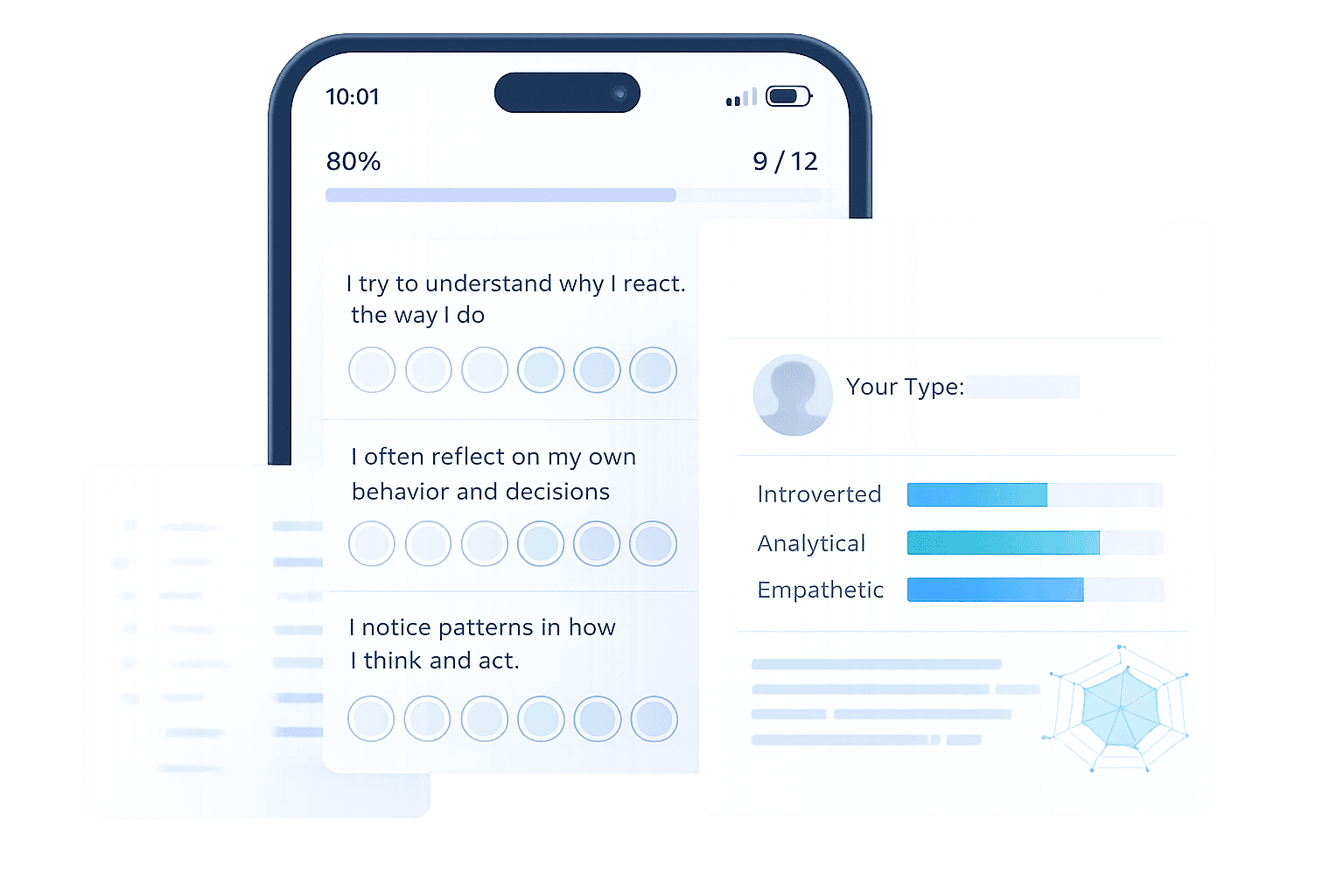

Look past the reaction itself
A sharp reply, a need to keep the peace, a push for control or a habit of withdrawing can look like separate moments. The test helps you examine whether those moments belong to a broader personality pattern with recurring motives and expectations behind it.

Follow the pattern into real life
Your report carries the result beyond a type name. Use it to compare how the same tendency may show up differently in relationships, work, stress, decision-making and the parts of yourself you are trying to develop.
How the personality-based Self Awareness Test works
Answer for the person you are most often
Work through 100 short statements using what is generally true for you. A useful result comes from your usual tendencies, not the version of yourself you wish were true or one unusually good or difficult day.
See which of nine personality patterns fits best
Your responses are scored across nine personality patterns. The result identifies the pattern with the strongest overall fit and becomes the starting point for your report.
Look for evidence, not just recognition
Read the report beside real examples from your life. Notice what fits quickly, what feels overstated, what depends on context and which descriptions help you ask a more specific question about yourself.
Use the result to make self-reflection more specific
Your dominant pattern is only the entry point. The detailed report explores the motivations and fears associated with that pattern, along with characteristic strengths and difficulties and the ways it may appear in relationships, work, stress and personal growth.
The useful part is the comparison. A description that fits gives you language for something you may already have sensed. A description that does not fit can help you separate a broad personality pattern from the parts of your experience that are more individual, situational or simply different.
Personality-based Self Awareness Test questions
Does this test measure how self-aware I am?
Does this test measure how self-aware I am?
No. Perself does not produce a self-awareness score or rank your ability to understand yourself. It uses a nine-pattern personality assessment as a structured prompt for self-understanding and reflection.
What result do I get?
What result do I get?
You receive one dominant personality pattern based on the overall shape of your answers, followed by a detailed report that explains the pattern in more depth.
Is this the same assessment as Perself's Enneagram and Personality tests?
Is this the same assessment as Perself's Enneagram and Personality tests?
Yes. Perself intentionally uses the same questionnaire, scoring foundation and report corpus. The Self Awareness Test is a different entry point for people whose goal is personality-based self-understanding rather than learning the Enneagram by name.
What does the detailed report cover?
What does the detailed report cover?
The report explores the pattern's main characteristics, motivations and fears, relationship tendencies, work themes, stress responses, growth areas and how it may interact with other patterns.
What if only part of the report feels like me?
What if only part of the report feels like me?
That is a reason to read more carefully, not to force the result to fit. Compare the report with examples from different settings and pay attention to both the descriptions that feel familiar and the ones that do not match your experience.
Is the Self Awareness Test a diagnosis?
Is the Self Awareness Test a diagnosis?
No. It is an educational self-reflection tool. It does not diagnose a mental-health, personality or neurodevelopmental condition and should not be used as a substitute for professional evaluation.
A personality framework gives self-reflection something concrete to examine
Self-reflection becomes more useful when it moves beyond a vague sense that you should know yourself better. A personality framework gives you specific claims to compare with your own experience: what tends to motivate you, how you respond when pressure rises, and which familiar strengths can become rigid when a situation matters to you.
The point is not to make every memory fit a type description. It is to compare. Where does the described motive appear? Which situations bring the tendency out? What does it help you do? When does the same tendency create friction in a relationship, decision or goal?
That comparison can turn a broad wish to understand yourself into something you can actually investigate. The report gives you a starting pattern; your own examples, exceptions and trusted feedback determine which parts deserve more attention.