
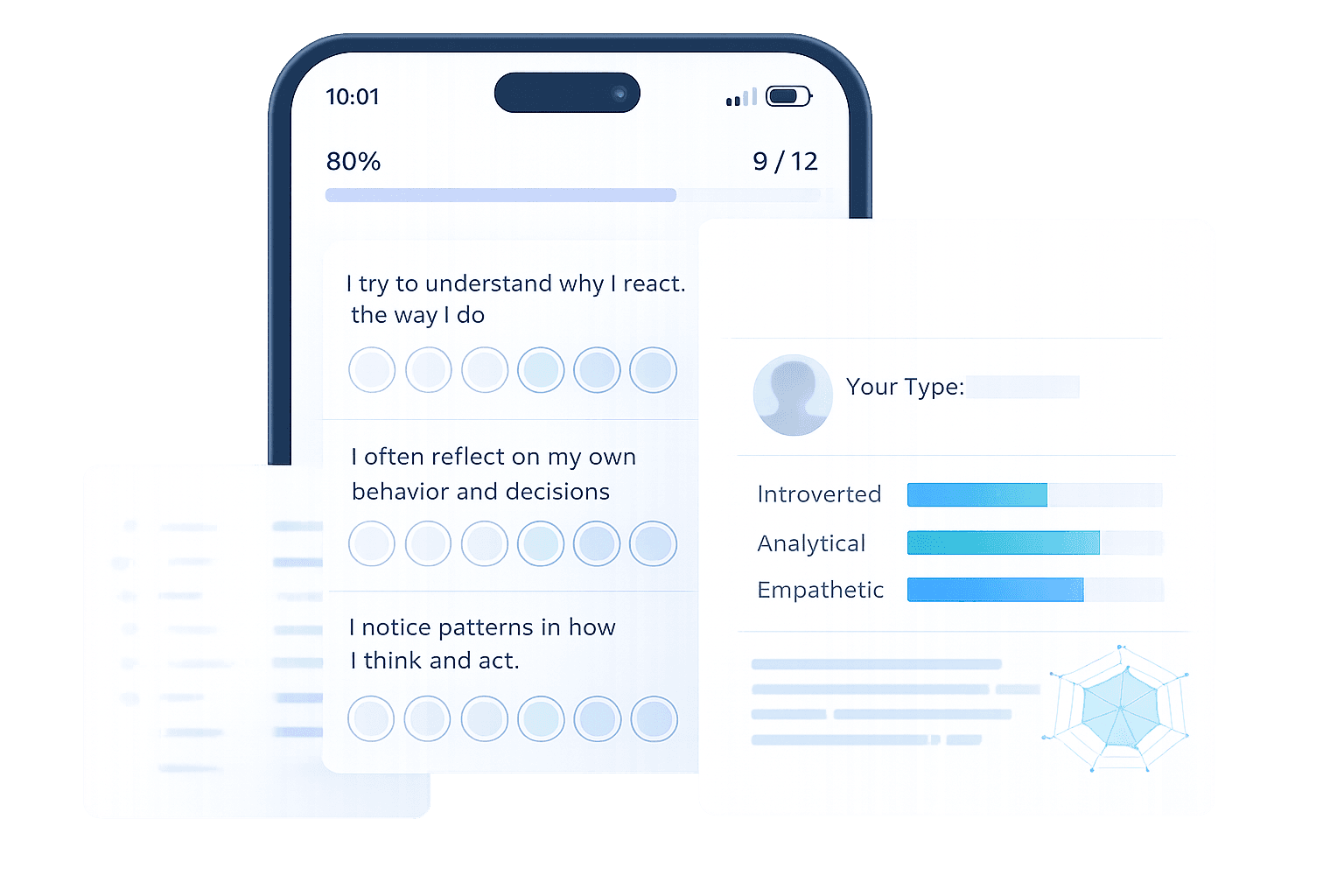

Start with one dominant pattern
Perself compares your answers across nine Enneagram types and identifies the strongest overall match instead of building an invented list of unrelated personality scores.
Follow that pattern into the parts of life that matter
The report expands into motivations and fears, relationships, career and work, stress and balance, growth, and compatibility context.
How your Enneagram profile comes together
Answer for your recurring pattern
Work through 100 statements and answer for what is generally true across your life, not only in one role or one unusually stressful week.
Identify the strongest match among nine types
Your responses are normalized across the nine Enneagram patterns and the highest overall match becomes the dominant type used for your report.
Read the type from several angles
Use the report sections to test the same pattern against motives, relationships, work, stress and growth instead of deciding whether it fits from a one-line description.
A profile is useful when the sections connect, not when they multiply labels.
Your report keeps one dominant Enneagram type at the center and examines it through several real-life lenses: key characteristics, motivations and fears, relationships, career and work, growth, stress and balance, and compatibility.
Perself does not calculate a wing, subtype or tritype in this assessment. The profile is deeper because it develops the type you actually received, not because it adds outputs the questionnaire did not score.
Enneagram profile questions
What is an Enneagram profile?
What is an Enneagram profile?
On Perself, your profile is the detailed report built around your dominant Enneagram type. It explains that pattern across motivations, relationships, work, stress, growth and compatibility themes.
Do I receive scores for every part of the profile?
Do I receive scores for every part of the profile?
No. The questionnaire scores the nine Enneagram types and identifies one dominant type. The report sections interpret that type; they are not separate relationship, career or growth scores.
Does the profile include my Enneagram wing?
Does the profile include my Enneagram wing?
No. Perself does not calculate a wing, instinctual subtype or tritype from this assessment.
Why read the full profile instead of only the type name?
Why read the full profile instead of only the type name?
A short label can sound familiar without telling you where the pattern appears. Looking across several sections gives you more concrete material to compare with your own life.
How do I access the complete profile?
How do I access the complete profile?
Complete the assessment to generate your personalized Enneagram profile, built around the dominant type reflected in your answers.
Is the Enneagram profile a psychological diagnosis?
Is the Enneagram profile a psychological diagnosis?
No. It is an educational personality framework for self-reflection and does not diagnose a mental-health condition.
A fuller profile should connect the same pattern across different parts of life
A personality profile becomes more useful when it shows continuity. A tendency that appears in relationships may look different at work, and a strength that helps when you feel secure may become rigid when you are under pressure. The question is whether those different moments still point back to a recognizable underlying motive.
Reading several sections around one dominant type lets you test that continuity. Does the motivation section make sense beside the relationship section? Does the stress pattern resemble what happens when expectations rise? Does the growth material address a real trade-off you already notice?
Depth comes from checking one hypothesis from several angles, not from collecting more labels. That is the purpose of the Perself profile.