
Notice the anxiety pattern that keeps repeating after the trigger changes
The situation may be different each time, but the sequence can feel familiar: uncertainty appears, your mind searches for certainty, tension rises, and you do something to feel safer for a while. This test helps you look for the pattern underneath those separate moments.
Look for the sequence, not only the trigger
A difficult email, an uncertain plan and a social event can seem unrelated. What may connect them is what happens next: forecasting, checking, tension, delay, reassurance or withdrawal. Comparing that sequence can reveal more than analysing one incident.
See what gives relief and what keeps returning
Some responses reduce anxiety in the moment without settling the underlying uncertainty. Your report gives you a broader view of recurring tendencies so you can notice which reactions actually help and which ones may keep the cycle active.
Follow the pattern from trigger to aftermath
Think across several situations
Answer from the patterns that recur across ordinary life. The goal is not to find your most dramatic anxious moment, but to notice what repeatedly happens before, during and after worry rises.
Receive one overall anxiety-traits level
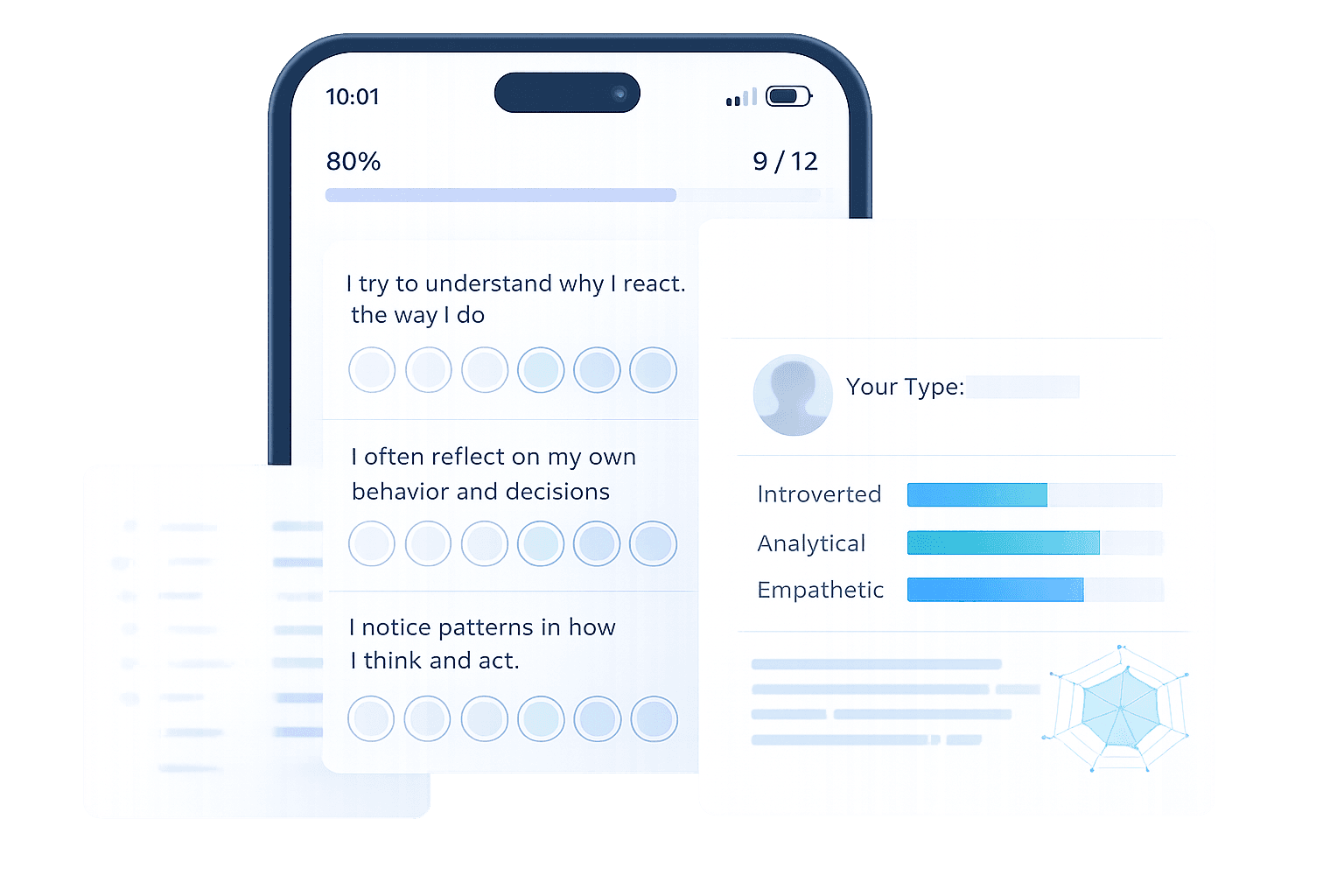
Your full set of answers is combined into a single level from Minimal Traits to Strong Traits. Perself does not return separate pattern or symptom-domain scores.
Use the report to find the recurring links
Compare the result with the situations that trigger worry, the way uncertainty feels, the responses you use to manage it and the effect those responses have afterwards.
A pattern becomes useful when you can recognise its turning points
The report does not assign you a named anxiety pattern. Instead, it gives context around your overall anxiety-traits level and describes ways worry, tension, uncertainty, social pressure and avoidance can influence daily life.
Use that context to ask a more practical question: where does the sequence change? You may notice a point where uncertainty becomes repeated checking, where tension becomes avoidance, or where a reassuring action only settles the worry briefly. Those turning points can be more informative than a label.
Questions about anxiety patterns
Does the test give me a named anxiety pattern?
Does the test give me a named anxiety pattern?
No. Perself gives one overall anxiety-traits level and a detailed report. The pattern framing on this page helps you examine recurring sequences in your own experience; it is not a separate classification system.
What kinds of patterns might I notice?
What kinds of patterns might I notice?
Examples include repeated worst-case thinking, difficulty tolerating uncertainty, physical tension, replaying social interactions, delaying stressful tasks, withdrawing, checking or seeking reassurance. The useful question is which of these actually repeat for you.
Why can anxiety return after I have reassured myself?
Why can anxiety return after I have reassured myself?
A response can reduce discomfort temporarily without changing the uncertainty that triggered it. If you repeatedly need more checking, preparation or reassurance, that sequence may be worth noticing in its own right.
Should I answer based on my worst anxious period?
Should I answer based on my worst anxious period?
Usually not. Answer according to what is most typical across ordinary life unless a statement specifically matches a recurring difficult period. One extreme episode can distort the broader picture.
Is an anxiety pattern the same as an anxiety disorder?
Is an anxiety pattern the same as an anxiety disorder?
No. People can recognise anxiety-related patterns without meeting criteria for a disorder. A diagnosis requires professional assessment and more context than an online self-report can provide.
Why the same anxiety cycle can hide behind different situations
Anxiety is often described by its content: money, health, work, relationships, travel, a decision. But the content can change while the process stays surprisingly similar. An unanswered question appears, the mind starts trying to remove uncertainty, and attention narrows around whatever might go wrong.
Behaviour can become part of that process too. Avoiding a difficult task, repeatedly checking for certainty or preparing far beyond what the situation requires may bring short-term relief. That does not mean those actions are always harmful; it means their role is worth noticing when the same loop keeps returning.
A self-report cannot tell you why a cycle exists or whether it is a clinical condition. It can help you compare moments that previously looked unrelated and give you more specific examples to reflect on or discuss with a professional if anxiety is affecting daily life.