
Explore obsessive-compulsive traits as recurring tendencies, not a fixed identity
Some patterns become most visible when uncertainty rises: a thought returns, a task does not feel complete, or reassurance never feels quite final. This assessment helps you examine which tendencies keep appearing across situations.
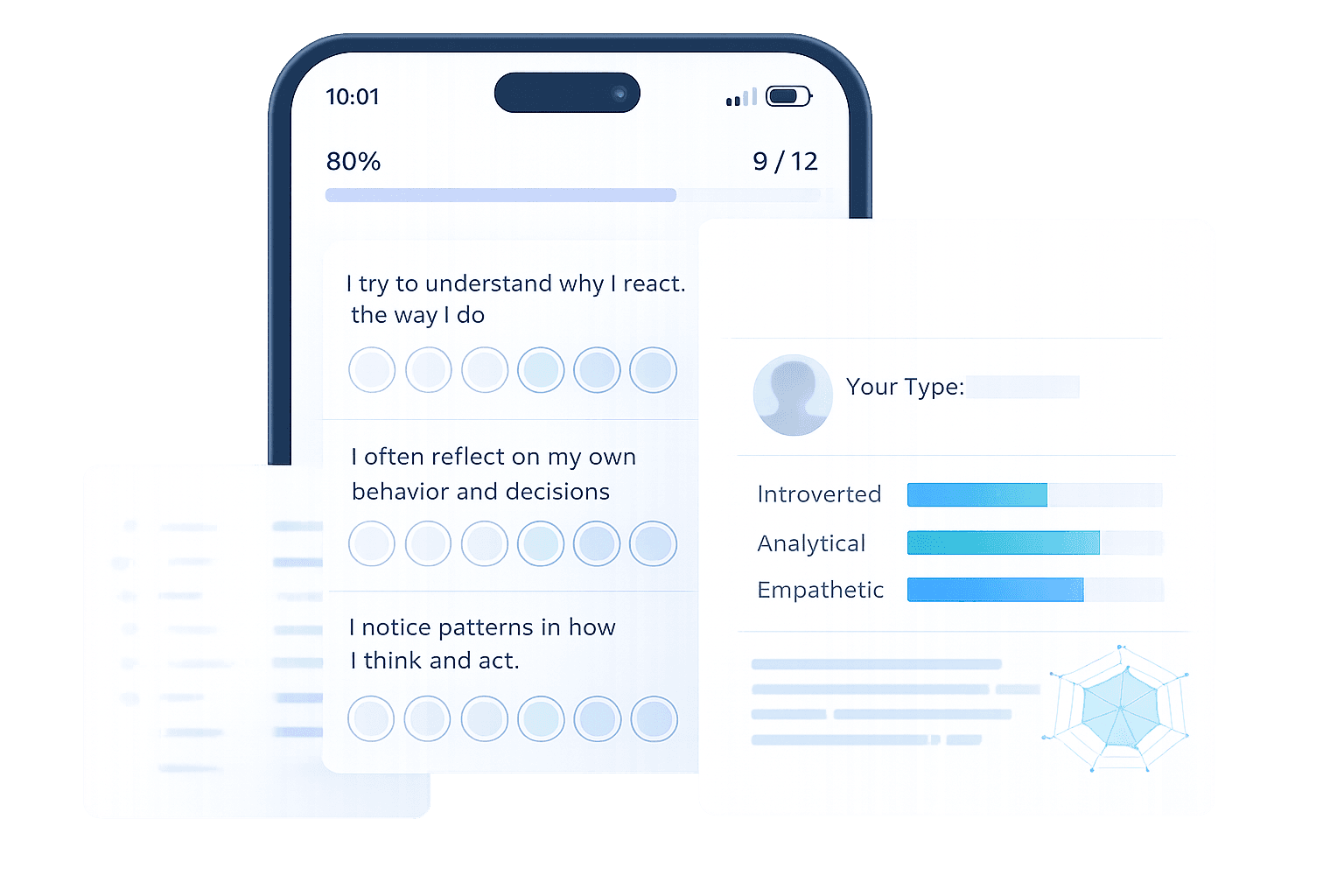

Look for tendencies that repeat across contexts
Reflect on whether intrusive thoughts, checking, repetition, order, certainty-seeking or mental review are isolated moments or patterns that keep returning in different parts of life.

Separate carefulness from a pattern that feels harder to leave
Being organised or double-checking something important is common. The more useful distinction is whether doubt repeatedly pulls you back after you already know a task is probably complete.
How to reflect on obsessive-compulsive traits
Think across ordinary weeks, not one difficult day
Use repeated experience as your reference point. Notice which thoughts, urges or routines appear reliably when responsibility, uncertainty or the possibility of a mistake feels important.
Notice whether the same tendency changes form
A need for certainty can appear as checking in one situation, mental review in another, or difficulty leaving a task unfinished somewhere else.
Use the result as a pattern to compare with your life
Your overall range is a starting point for reflection. Compare it with the situations where repetition, doubt or certainty-seeking feels most familiar rather than treating it as a clinical label.
The report describes an overall tendency range, not separate trait scores
Your answers produce one overall result across five ranges. The report then uses recurring themes such as intrusive thoughts, checking, mental review, routines, certainty and relief to help make that result easier to recognise in daily life.
Those themes are not separate diagnostic dimensions and Perself does not determine whether you have obsessive-compulsive disorder. The goal is to help you notice whether similar responses keep appearing strongly enough to deserve more attention.
Obsessive-compulsive traits questions
What are obsessive-compulsive traits?
What are obsessive-compulsive traits?
The phrase can describe recurring tendencies such as intrusive thoughts, repeated checking, mental review, certainty-seeking, rigid routines or difficulty moving on when something does not feel complete. These experiences can vary widely in frequency and impact.
Are obsessive-compulsive traits the same as OCD?
Are obsessive-compulsive traits the same as OCD?
No. Recognising some related tendencies does not establish obsessive-compulsive disorder. Diagnosis depends on a fuller clinical assessment, including distress and interference with daily functioning.
Does this assessment tell me which OCD subtype I have?
Does this assessment tell me which OCD subtype I have?
No. Perself gives one overall traits range and does not diagnose OCD subtypes or provide separate clinical symptom scores.
Why does the test include both thoughts and behaviours?
Why does the test include both thoughts and behaviours?
Obsessive-compulsive patterns can involve both recurring internal experiences and responses intended to reduce uncertainty or discomfort. Looking at them together can make a repeating cycle easier to recognise.
When is professional support worth considering?
When is professional support worth considering?
If intrusive thoughts, checking, repetitive actions or mental rituals are persistent, distressing or interfering with daily life, a qualified mental-health professional can provide a proper assessment and discuss appropriate support.
A trait becomes more informative when you ask what keeps it going
The same outward behaviour can have different meanings. Rechecking a detail once before an important deadline is different from returning again because the feeling of certainty never arrives. A routine can be convenient in one setting and feel difficult to interrupt in another.
That is why the useful unit is not one isolated habit. It is the recurring relationship between a thought or doubt, the discomfort it creates, the response you use to settle it, and how long that relief lasts.
Reading traits this way keeps the result specific without turning it into a diagnosis. It gives you a way to compare repeated tendencies with real experience and notice where they are merely familiar versus where they are beginning to cost you time, energy or flexibility.