
Examine psychopathy traits as a broader pattern, not one stereotype
Psychopathy is usually discussed through several connected tendencies: emotional detachment, reduced empathy or remorse, strategic interpersonal behaviour, and a more impulsive or risk-focused style. Perself lets you compare those themes with your own recurring behaviour.
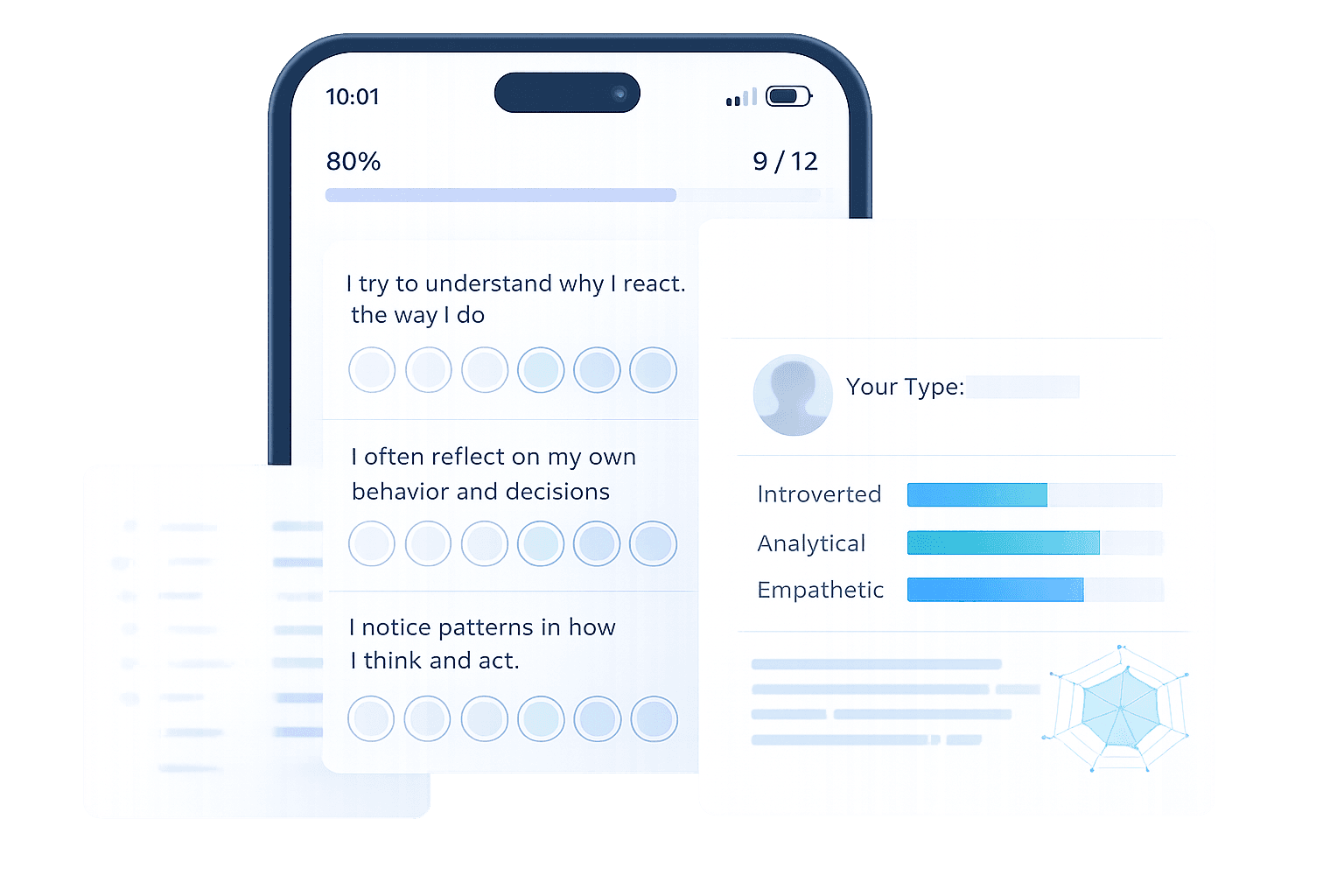

See how emotional and interpersonal tendencies connect
The same person can be composed under pressure, less emotionally affected by other people, socially adaptable and highly focused on outcomes. The useful signal is the combination and how consistently it appears.

Add risk, impulse and accountability to the picture
A fuller psychopathy-traits view also asks what happens around consequences: whether risk feels exciting, whether decisions are slowed down by possible harm, and how much guilt or responsibility changes what you do next.
How to read a psychopathy test without oversimplifying it
Answer across different parts of life
Think about relationships, competition, conflict, responsibility and pressure. One setting can exaggerate or hide a tendency that looks different elsewhere.
Focus on the combined direction
The result reflects an overall psychopathy-traits range. It does not diagnose a disorder or return separate clinical factors.
Use the report to test the interpretation
Compare the result with your emotional experience, accountability, social strategy, risk choices and the impact your behaviour has on other people.
The report follows the construct into ordinary life
Your result begins with an overall psychopathy-traits range. The report then gives that score context by discussing emotional control and detachment, empathy, guilt and responsibility, relationships, social strategy, independence, decision-making and outcome-focused thinking.
That matters because traits that look similar from the outside can have different meanings. Calmness may support good decisions or create distance. Social confidence may support connection or become primarily instrumental. Independence may be healthy autonomy or make accountability and vulnerability harder to tolerate.
Psychopathy test questions
What does a psychopathy test usually look at?
What does a psychopathy test usually look at?
Psychopathy research commonly discusses affective and interpersonal tendencies such as shallow emotional response, low empathy or remorse and manipulativeness alongside behavioural themes such as impulsivity, irresponsibility and risk-taking. Different instruments organise these themes differently.
Does Perself give primary and secondary psychopathy scores?
Does Perself give primary and secondary psychopathy scores?
No. Perself gives one overall psychopathy-traits result and a narrative report. It does not return primary/secondary psychopathy sub-scores or named clinical factors.
Is psychopathy the same as antisocial personality disorder?
Is psychopathy the same as antisocial personality disorder?
They overlap in some research and clinical discussions but are not interchangeable terms. Psychopathy places particular emphasis on interpersonal and affective traits as well as behavioural tendencies.
Does this test use the Psychopathy Checklist-Revised?
Does this test use the Psychopathy Checklist-Revised?
No. The PCL-R is a professional assessment with its own administration and evidence requirements. This Perself test is a separate educational self-report assessment.
Can a high result show that someone is dangerous?
Can a high result show that someone is dangerous?
No. This test does not predict violence, criminal behaviour or dangerousness. Those conclusions cannot be drawn from an online self-report trait score.
What should I do with the result?
What should I do with the result?
Use it to compare the report with repeated examples from your own life. If behaviour is causing harm, serious relationship problems or safety concerns, a qualified professional can provide context an online test cannot.
Psychopathy is broader than emotional coldness
Popular descriptions often reduce psychopathy to a lack of empathy. Research models are broader. They commonly include interpersonal features such as manipulation or superficial charm, affective features such as reduced remorse, and behavioural or lifestyle features such as impulsivity and risk-taking.
That broader view changes the questions worth asking. Emotional distance may coexist with strong self-control. Strategic social behaviour may be highly deliberate, while risk-taking may be fast and poorly considered. Accountability can look different again, especially when practical outcomes matter more than emotional consequences.
A self-report result cannot reproduce a professional psychopathy assessment. Its value is narrower: giving you a coherent way to compare several recurring tendencies with the way you actually behave across situations.