
Use the Five Factor model without turning personality into a fixed type
The Five Factor approach describes personality across five broad dimensions rather than forcing everyone into a small set of categories. Perself uses that framework to identify the trait pattern that stands out most strongly in your answers.
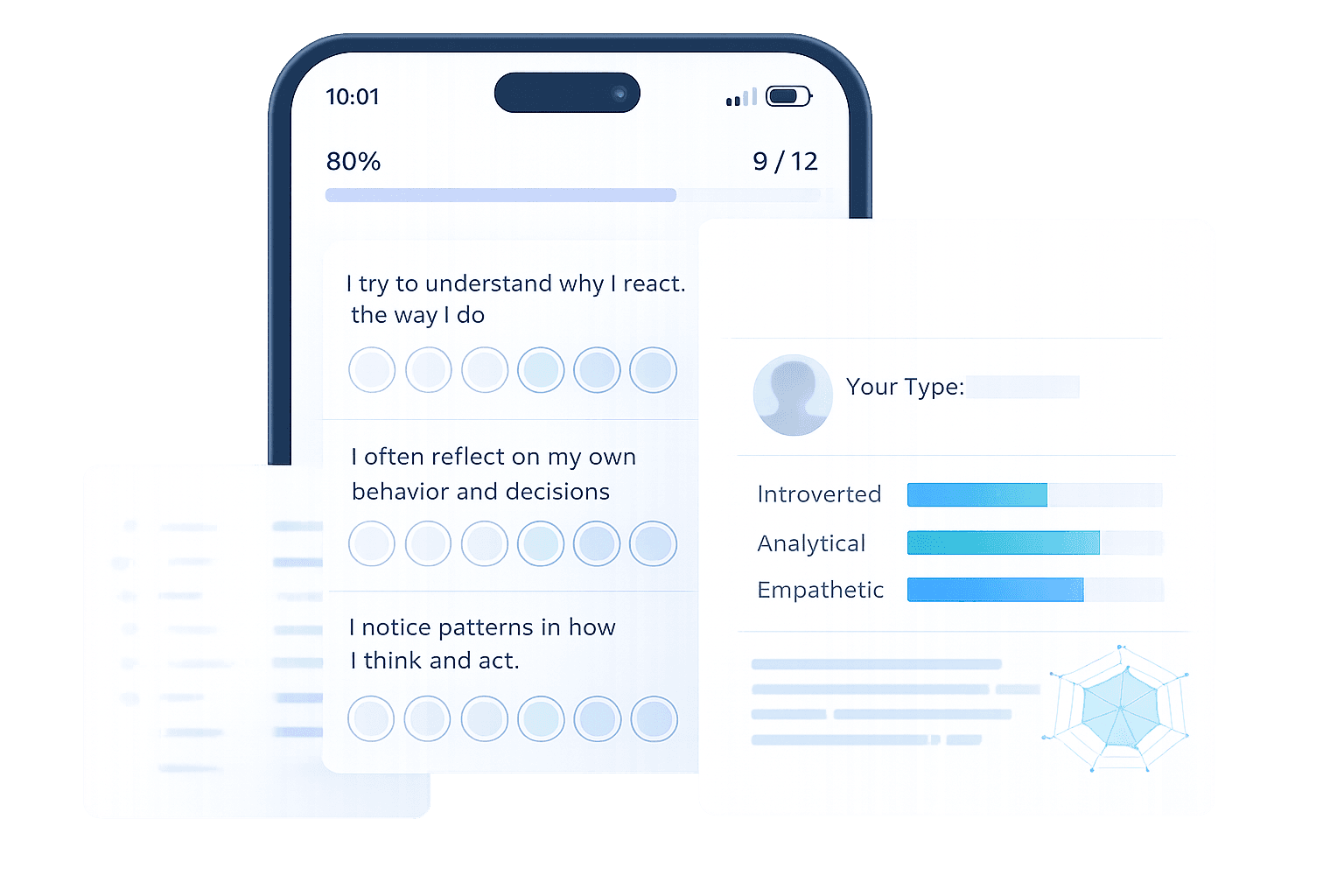

Think in dimensions instead of boxes
The Five Factor model looks at openness, conscientiousness, extraversion, agreeableness, and neuroticism as broad tendencies. You can show every one of them to a different degree rather than belonging to a single all-or-nothing type.

Start with the factor that stands out most
Perself compares the five dimensions and builds your detailed report around the strongest trait pattern, giving you a practical way to connect the framework with relationships, work, stress, and growth.
How the Five Factor test turns a framework into something personal
Answer from repeated tendencies
Think across time and settings rather than answering from one role or one recent mood. The goal is to capture the behaviours and preferences that recur most often.
Score the five broad factors
Your responses contribute to openness, conscientiousness, extraversion, agreeableness, and neuroticism so the strongest dimension can be identified.
Use the dominant factor as a starting point
The report develops the leading trait through strengths, motivations, relationships, career themes, stress, balance, and personal growth rather than treating it as a complete personality verdict.
The framework is broad. Your report makes it specific.
The Five Factor Model is often used in research and professional personality measurement, but Perself is not claiming to administer a particular validated instrument such as the NEO-PI-R, IPIP-NEO, or BFI-2. It uses its own questionnaire built around the same five broad trait labels.
The result is intentionally easier to read than a full psychometric profile: the strongest factor becomes the organising theme, and the detailed report explores what that tendency may look like across important parts of life.
Five Factor personality test questions
Is the Five Factor Model the same as the Big Five?
Is the Five Factor Model the same as the Big Five?
They are closely related terms for the same broad five-dimension approach to personality: openness, conscientiousness, extraversion, agreeableness, and neuroticism.
Why use five factors instead of personality types?
Why use five factors instead of personality types?
Dimensions allow people to show each trait to different degrees. That avoids treating personality as though everyone must fit neatly into one fixed category.
Is this a validated Five Factor inventory?
Is this a validated Five Factor inventory?
Perself uses its own educational questionnaire. It is not the NEO-PI-R, IPIP-NEO, BFI-2, or another named professional inventory and should not be interpreted as equivalent to one.
What result will I receive?
What result will I receive?
Perself identifies the Big Five factor that is strongest in your responses and provides a detailed report around that dominant trait. The experience is not a five-percentile norm report.
Can a factor be both a strength and a challenge?
Can a factor be both a strength and a challenge?
Yes. Broad personality tendencies can be helpful in one context and less useful in another. A strong trait is not automatically better or worse; what matters is how it interacts with the situation and your goals.
Can I use this result as a professional assessment?
Can I use this result as a professional assessment?
No. Perself is for education and self-reflection. Professional assessment requires appropriate instruments, norms, interpretation, and context.
A dimension gives you more room than a label
You do not have to choose between being “an organised person” and “a spontaneous person” as though only one can ever be true. Personality dimensions are useful because they leave room for degree, context, and competing tendencies.
That is closer to how people actually behave. A person may be highly conscientious at work and relaxed about household routines, or socially energetic in familiar groups while quiet in new ones.
Perself uses the Five Factor framework to find the strongest signal in your answers, then gives that signal enough context to become something you can reflect on rather than just another label to collect.