
What tends to happen first when you empathize?
Do you understand another person's viewpoint, feel their emotion in your own body, move quickly to help, or protect your distance until you know more? Use the test to reflect on the way empathy tends to show up for you.
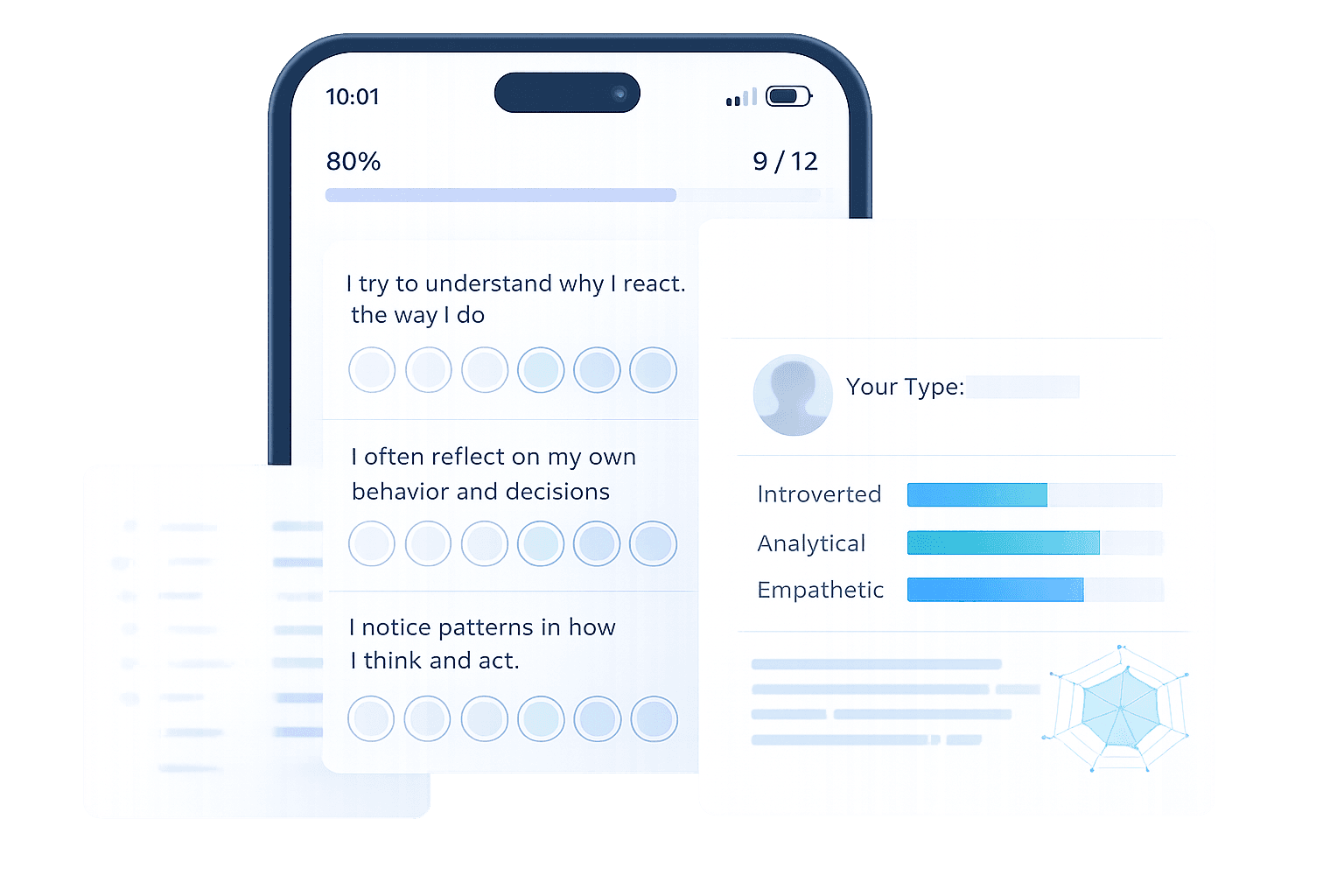

Compare different ways empathy can appear
Understanding, emotional resonance, compassionate action and social sensitivity can all look empathetic, but they do not always appear at the same strength or in the same order.

Include boundaries in the picture
A useful empathy style is not only about what you give other people. It also includes how much emotional information you absorb and how well you protect your own capacity.
Look at the way your empathy tends to work
Notice your default entry point
Think about whether you usually begin with understanding the situation, feeling the emotion, taking action, asking questions or creating some distance.
Compare that response across situations
Your style may look different during conflict, with strangers, with people you love, or when you are already emotionally tired.
Use the result as a description, not a box
The report can help you name the empathy tendencies that feel familiar without turning them into a fixed personality type.
An empathy style is more useful as a pattern of emphasis than as a label.
Popular empathy-style frameworks often talk about cognitive empathy, affective empathy and compassionate empathy. Those distinctions are useful because understanding, feeling and helping are different processes. Your Perself result is broader: it places your overall responses in an empathy range and then helps you reflect on the tendencies that contribute to it.
That means you may recognize a style in the report without receiving a named type. The practical value is seeing which part of empathy tends to lead, which part is harder, and what happens when sensitivity becomes emotional load rather than connection.
Questions about empathy styles
What are common empathy styles?
What are common empathy styles?
A common distinction is between cognitive empathy (understanding another perspective), affective or emotional empathy (feeling with someone), and compassionate empathy (being moved to respond or help). Real people often show a mix rather than one pure style.
Does this test give me a cognitive, emotional or compassionate empathy type?
Does this test give me a cognitive, emotional or compassionate empathy type?
No. The assessment gives an overall empathy result and report. This page uses those familiar distinctions to help you interpret how empathy may show up, without promising a separate categorical type result.
Can someone understand emotions without feeling them strongly?
Can someone understand emotions without feeling them strongly?
Yes. Cognitive empathy and emotional resonance are related but distinct. Someone can be good at understanding another point of view while remaining relatively emotionally steady.
Can strong emotional empathy become draining?
Can strong emotional empathy become draining?
It can. High sensitivity or emotional absorption can make intense environments harder to leave behind, which is why boundaries and recovery matter alongside compassion.
Can my empathy style change?
Can my empathy style change?
Context, stress, trust, experience and practice can change which response comes most naturally. Treat the result as a reflection of current tendencies rather than a permanent identity.
Understanding, feeling and helping are not the same thing
One person may immediately feel a friend's sadness. Another may stay emotionally calm but ask the question that finally makes the friend feel understood. A third may show care by bringing dinner, solving a practical problem or protecting time to listen later.
Thinking in styles is useful when it helps you notice those differences. It becomes less useful when it turns empathy into a badge or assumes one response is always superior to another.