
Take a personality test that gets beneath the obvious traits
The same motive can show up as ambition, caution, helpfulness, independence, high standards or a need to keep the peace. Perself looks across those recurring reactions to identify your strongest personality type and give you a fuller explanation of what may be driving it.
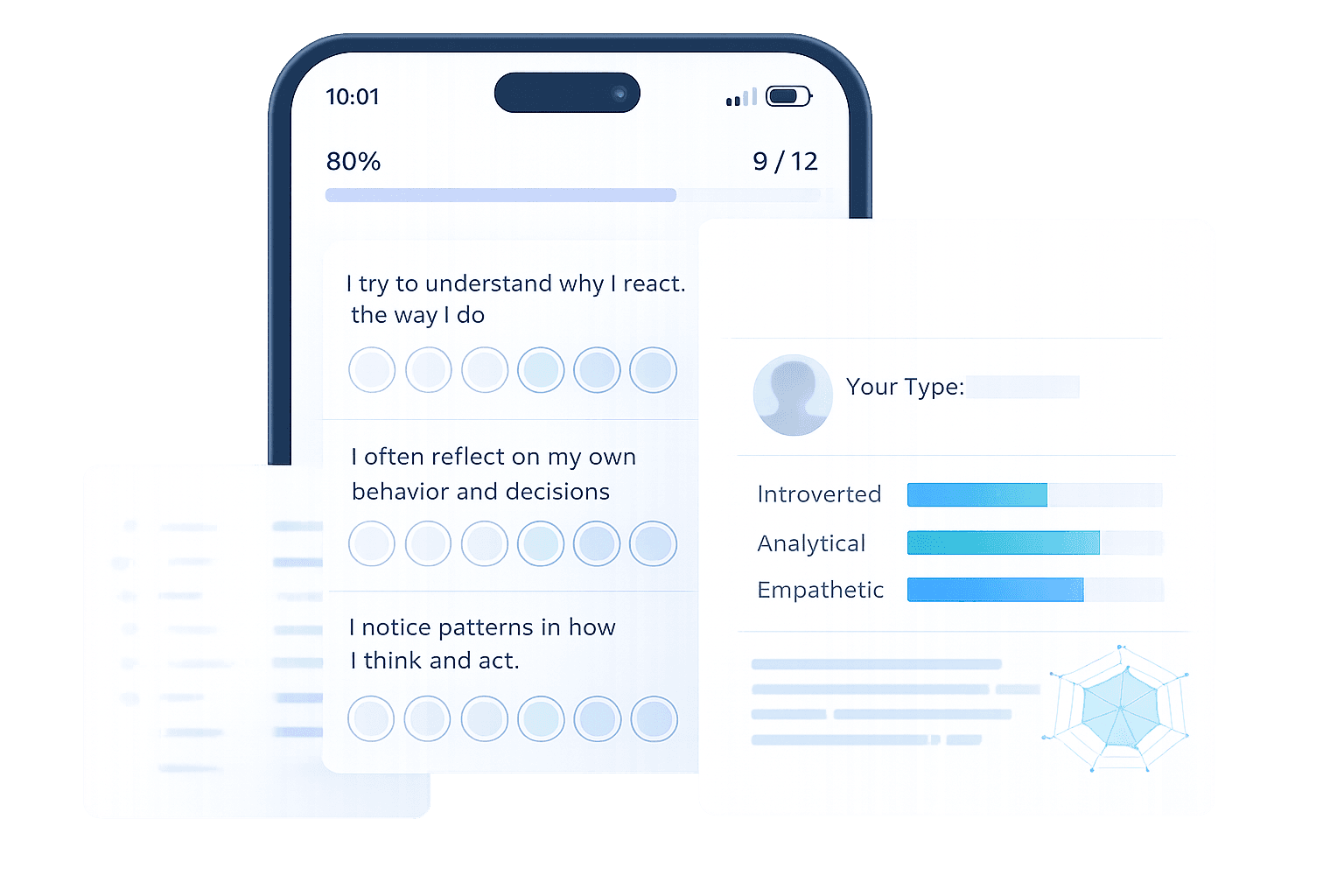

Get a personality type you can recognise in real life
Your result identifies the strongest of nine personality types in your answers, then explains the motivations, fears, strengths and blind spots associated with that pattern.
See where the same pattern changes with context
A tendency that helps you at work can create friction under stress or in a close relationship. The report follows your type across decisions, relationships, career, pressure and personal growth instead of stopping at a short label.
From your answers to a personality type you can examine
Answer for what is usually true
Rate statements about your typical preferences, reactions and behaviour. Try to answer from repeated experience rather than the version of yourself you would most like to be.
See which of nine types is strongest
Your answers are scored across nine personality types. The type with the strongest overall pattern becomes the starting point for your result.
Read the type in the context of your life
Go beyond the name of the type and compare the report with your motivations, relationships, work, stress responses and the growth areas that actually feel familiar.
Your report goes beyond the type name
The result opens with your dominant personality type and an overview of the pattern behind it. From there, the report explores key characteristics, primary motivations and core fears, so you can see why two people who look similar from the outside may still be driven by very different things.
You can then follow that type into relationships, work, stress and personal growth. The useful question is not whether every sentence fits perfectly; it is which parts explain something you already live with and which parts give you a better question to ask about yourself.
Personality test questions
What result does this personality test give me?
What result does this personality test give me?
You receive one dominant personality type from a nine-type system, followed by a detailed report about that type's characteristics, motivations, fears, relationships, work patterns, stress responses and growth themes.
Is this a Big Five personality test?
Is this a Big Five personality test?
No. A Big Five test reports separate scores for traits such as Openness, Conscientiousness, Extraversion, Agreeableness and Neuroticism. Perself uses a nine-type personality model and gives you a dominant type rather than five Big Five trait scores.
Is this an MBTI or 16 personalities test?
Is this an MBTI or 16 personalities test?
No. The result is not a four-letter MBTI-style code and it does not sort you into one of 16 types. Perself uses its own nine-type scoring and report system.
What should I think about while answering?
What should I think about while answering?
Choose what is usually true across ordinary situations. A repeated reaction is more useful than one unusually stressful week or one idealised version of how you think you should respond.
Can more than one personality type sound like me?
Can more than one personality type sound like me?
Yes. People can recognise themselves in qualities associated with several types. Your result highlights the strongest pattern in your answers, while the full report is there to help you judge how well that interpretation fits your actual experience.
Is a personality type a diagnosis or a fixed identity?
Is a personality type a diagnosis or a fixed identity?
No. This test is for self-reflection and education. A personality type is a way to organise patterns in your answers, not a medical diagnosis or a rule about what you can become.
A useful personality result explains more than what you do
Two people can both work hard, avoid conflict or take charge and still be doing it for different reasons. One may be protecting a standard, another may be looking for security, recognition, independence or harmony. That difference in motive is often where a type description becomes more useful than a list of adjectives.
Context matters too. A strength can become less helpful when pressure rises. Carefulness can turn into self-criticism, helpfulness can become overextension, confidence can become control, and flexibility can become avoidance. The report gives you several parts of life to compare rather than asking you to accept one flattering summary.
Treat the result as a hypothesis about a recurring pattern. The strongest value comes from checking it against examples you know: how you react to feedback, what you fear losing, what you need from close relationships and what tends to happen when you are stretched beyond your usual balance.